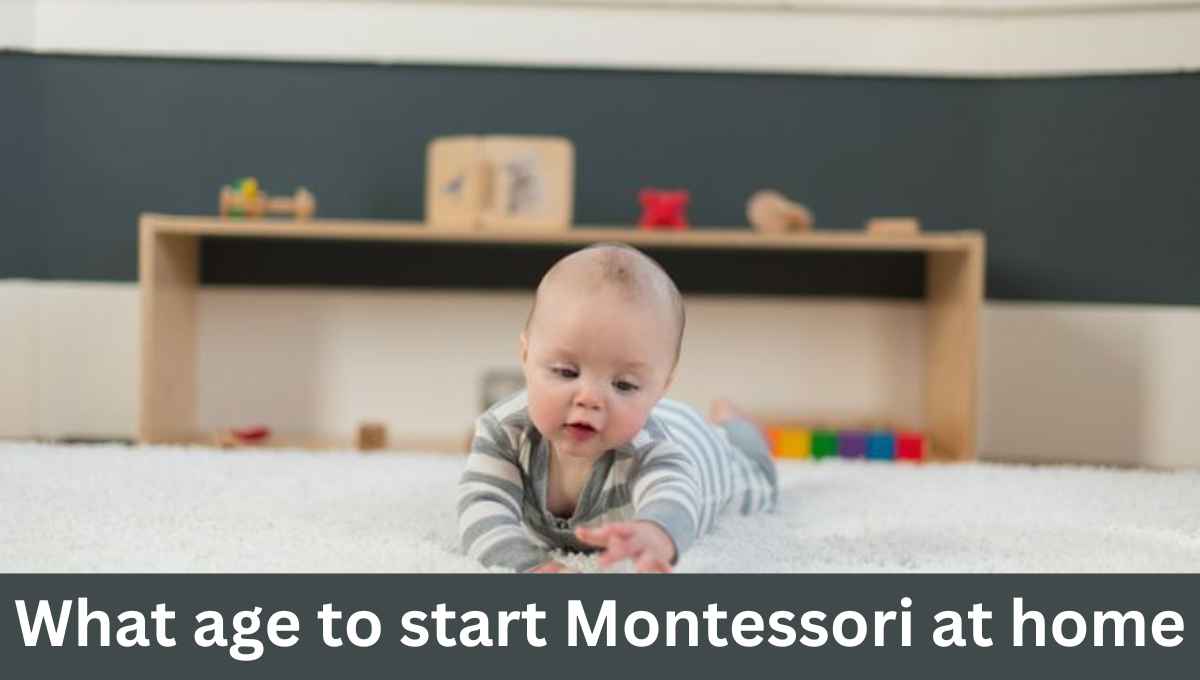
The Montessori approach can be introduced at home from a very young age. It is based on the idea that children are naturally curious and capable of learning independently. While there is no specific age requirement, you can begin implementing Montessori principles as early as infancy.
In the first few months of your child’s life, you can create a Montessori-inspired environment at home. This involves providing a safe, organized, and visually appealing space for your child to explore. You can have low shelves with simple toys or objects within reach, a floor mirror for self-discovery, and an area for your child to move around and explore.
The Ideal Age to Start Montessori at Home
Montessori principles can be introduced from infancy.
Montessori principles can be introduced from the very beginning, even during infancy. The Montessori approach recognizes that babies have an innate ability to learn and explore their environment. By creating a nurturing and prepared environment, parents can support their infant’s natural development and curiosity.
From the earliest days, parents can provide a safe and orderly space for their baby to move and explore. Low shelves with simple toys or objects, a floor mirror, and a designated area for movement are some elements that can be incorporated. These encourage the baby to develop their senses, practice motor skills, and discover the world around them.
🌍 More Available Jobs



As the baby grows, Montessori activities can be introduced to further stimulate their development. These activities can include sensory play, object exploration, and basic self-care tasks like feeding and dressing. Through these activities, infants can learn to be independent, build fine motor skills, and develop their cognitive abilities.
The key is to follow the baby’s lead, observe their interests and abilities, and provide them with developmentally appropriate materials and activities. By starting Montessori principles from infancy, parents can lay the foundation for a lifelong love of learning and independence in their child.
There is no strict age requirement.
There is no fixed age to start Montessori at home because it depends on your child’s unique needs and development. Every child grows and learns at their own pace, so you can introduce Montessori principles whenever you feel your child is ready.
🌍 More Available Jobs



The Montessori approach emphasizes the individuality of each child. It recognizes that children have different interests, abilities, and developmental timelines. Therefore, there is no strict age requirement to start Montessori at home.
Some children may show signs of readiness for Montessori activities at an early age, while others may need more time to develop certain skills. For example, a child who demonstrates a strong desire for independence, shows curiosity in exploring their environment, and has developed basic motor skills may be ready for Montessori activities at an earlier age. On the other hand, some children may need more time to develop their fine motor skills, coordination, or ability to concentrate before fully engaging in Montessori activities.
As a parent, you are the best judge of your child’s readiness. You can observe their behavior, interests, and abilities to determine when to introduce Montessori principles at home. Look for signs of curiosity, independence, and a desire for exploration. Pay attention to their motor skills, cognitive development, and level of concentration. These observations will help you gauge when your child might be ready for Montessori activities.
Observing the child’s readiness for different activities and materials
Observing a child’s readiness for different activities and materials is crucial in the Montessori approach because it ensures that the child is engaged in learning experiences that are suitable for their specific developmental stage and individual interests.
Here’s why it’s important in more detail.
Tailored Learning
Children develop at their own pace and have different strengths and interests. By observing their readiness, parents can select activities and materials that are appropriately challenging and aligned with their abilities. This helps ensure that the child remains interested, motivated, and engaged in the learning process.
Success and Confidence
When children are provided with activities and materials that match their readiness, they are more likely to experience success and build confidence in their abilities. This fosters a positive attitude towards learning and encourages them to explore and take on new challenges.
Optimal Skill Development
Each activity and material in the Montessori approach is carefully designed to promote specific skills and concepts. By observing a child’s readiness, parents can introduce activities that target the child’s current developmental needs. This promotes the acquisition of new skills, such as fine motor skills, problem-solving abilities, concentration, and language development, at the right time in their development.
Interest and Engagement
Observing a child’s interests helps parents select activities and materials that align with their natural curiosity. When children are engaged in activities that capture their attention and spark their interest, they become active learners, exploring and discovering the world around them with enthusiasm. This promotes a love for learning and intrinsic motivation.
Individualized Approach
Montessori education values the uniqueness of each child. By observing their readiness, parents can provide an individualized approach to learning, catering to their specific needs, strengths, and preferences. This allows children to progress at their own pace and encourages the development of their full potential.
Montessori Activities for Different Developmental Stages
Montessori activities are designed to support children’s development at different stages.
Infancy (0-12 months)
Sensory Exploration
Provide objects with different textures, shapes, and colors for babies to touch, explore, and observe.
Object Permanence
Play games like peek-a-boo or hide-and-seek with toys to help babies understand that objects still exist even when they can’t see them.
Gross Motor Skills
Encourage tummy time, crawling, and rolling to help babies develop their physical strength and coordination.
Toddlerhood (1-3 years)
Practical Life Skills
Engage toddlers in activities like pouring water, sorting objects, and buttoning clothes to develop their fine motor skills and independence.
Language Development
Read books, sing songs, and engage in conversations to support toddlers’ language skills and vocabulary.
Fine Motor Skills
Offer materials like puzzles, stacking blocks, and threading beads to enhance hand-eye coordination and dexterity.
Preschool (3-6 years)
Math Skills
Introduce counting, sorting, and basic arithmetic using hands-on materials like number rods, counting beads, and number puzzles.
Sensorial Activities
Provide activities that engage the senses, such as matching colors, grading sizes, and exploring different scents and textures.
Language and Literacy
Encourage preschoolers to write, read books together, and engage in storytelling activities to enhance their language and literacy skills.
These Montessori-inspired activities at home provide children with opportunities for self-directed learning, independence, and exploration. The focus is on creating an engaging environment that fosters their development, nurtures their curiosity, and encourages a love for learning within the familiar setting of home.
Benefits of Montessori at Home
Montessori at home offers several benefits for children.
Independence
Montessori encourages children to be self-sufficient and take responsibility for their actions. It promotes independence by providing opportunities for children to choose activities, care for themselves and their environment, and make decisions.
Hands-on Learning
Montessori activities emphasize hands-on learning experiences, allowing children to engage their senses and actively explore the world around them. This approach fosters a deeper understanding of concepts and encourages critical thinking and problem-solving skills.
Individualized Pace
Montessori recognizes that every child learns at their own pace. At home, parents can tailor activities to their child’s needs, interests, and abilities. This individualized approach ensures that children can progress at a pace that suits them, building confidence and a love for learning.
Order and Organization
Montessori environments at home promote order and organization. By having designated spaces for materials and activities, children learn to take care of their belongings and develop a sense of responsibility for their environment.
Focus on Whole Child Development
Montessori focuses on nurturing the development of the whole child, including cognitive, social, emotional, and physical aspects. Activities at home can address various areas of development, supporting well-rounded growth.
Love for Learning
Montessori at home cultivates a love for learning by providing children with engaging, child-centered activities. It encourages curiosity, creativity, and a sense of wonder, fostering a lifelong passion for acquiring knowledge and exploring new ideas.
Parent-Child Bonding
Implementing Montessori principles at home allows parents to actively engage with their children in the learning process. This strengthens the parent-child bond and provides opportunities for shared experiences, communication, and support.
Montessori at home promotes independence, hands-on learning, individualized pace, order and organization, whole child development, a love for learning, and parent-child bonding. These benefits contribute to a positive and enriching educational experience that supports children’s growth and development.
What Age to Start Montessori at Home: The Complete Birth-to-Six Parent Guide
What Age to Start Montessori at Home
Parents frequently ask when to start Montessori at home to maximize their child’s intellectual and emotional potential. The answer surprises many families because the journey starts from the newborn stage. Dr. Maria Montessori observed that learning begins at birth during the period of birth to three.
During these early months, the human brain develops faster than at any other point in life. The absorbent mind allows infants to effortlessly soak up environmental inputs without conscious effort. Evaluating age appropriateness ensures parents introduce the right activities without overstimulating their infant.
Establishing a solid early childhood education framework at home provides lifelong developmental advantages. Children pass through distinct sensitive periods where learning specific skills becomes second nature. Tailoring your household environment aligns with natural infant development.
A predictable toddler routine fosters psychological safety and order. Nurturing child autonomy encourages toddlers to master personal care and explore their surroundings confidently. This holistic approach supports natural development rather than forcing rigid artificial benchmarks.
Effective home learning transforms daily domestic activities into powerful educational moments. Tracking developmental milestones helps parents offer materials that match their child’s evolving capabilities. Embracing these principles throughout toddlerhood lays a foundation for lifelong curiosity.
Even during the initial newborn stage, simple visual tracking exercises enrich neural connections. Engaging in calm sensory exploration strengthens motor skills and cognitive processing. Designing a prepared environment allows freedom of movement without unnecessary physical barriers.
Embracing child-centered learning honors each individual child’s unique growth timeline. Adopting this proven educational framework builds self-discipline, resilience, and problem-solving abilities. Ultimately, this early structure forms an enduring early learning foundation for future academic and life success.
The Montessori Philosophy from Birth: Absorbent Mind and Sensitive Periods
Understanding how young children process reality requires exploring the concept of the unconscious absorbent mind. From birth to age three, infants absorb sights, sounds, and language effortlessly from their surroundings. They do not analyze information logically; instead, they integrate every sensory detail directly into their developing nervous system.
Around age three, children transition into the conscious absorbent mind phase, where they intentionally organize and classify their experiences. During this period, parents observe a powerful sensitive period for order, where toddlers thrive on routine, predictability, and precise object placement. Disruptions in domestic order often trigger toddler frustration, as external structure provides internal calm.
Simultaneously, children undergo a sensitive period for language, rapidly absorbing vocabulary, grammar, and pronunciation from adult conversation. Exposing infants to rich, articulate speech builds linguistic clarity and expressive confidence. Another major window is the sensitive period for movement, where babies transition from rolling to crawling and walking.
Sensory activities support the gradual refinement of senses, teaching children to differentiate subtle variations in touch, sound, color, and texture. Unlike traditional reward systems, this framework relies on internal motivation, fostering a genuine love for discovery. Children engage in self-directed activity, choosing tasks that fulfill their current developmental needs.
Parents establish boundaries through freedom within limits, allowing independent exploration within a completely child-proofed space. Sharpening your personal observation skills enables you to step back and understand what your child attempts to master. Early interactions directly shape early brain architecture, establishing resilient biological structures.
Repeated sensory experiences construct complex cognitive neural pathways that support future critical thinking. Honoring a child’s natural curiosity prevents learning burnout and encourages deep concentration. Insights from modern child psychology validate Maria Montessori’s original findings on infant cognition.
Providing age-appropriate tactile stimulation enhances fine motor dexterity and brain connection. High-contrast visual art supports early visual tracking during the first four months. Speaking calmly cultivates auditory awareness and emotional stability.
Creating a serene environment yields deep emotional security, allowing infants to explore without fear. These practices align perfectly with universal human tendencies for order, communication, and environmental mastery. Starting at home cultivates positive lifelong learning habits that benefit children into adulthood.
Infant Stage (Birth to 12 Months): Preparing the Home Nido Environment
Designing a dedicated home nido setup creates a peaceful sanctuary tailored specifically for an infant. In Italian, “Nido” translates to “nest,” symbolizing a safe, warm space where babies move freely. Replacing traditional cribs with floor beds prioritizes floor bed safety while granting unrestricted visual access to the room.
Installing a low mirror on the wall next to a soft floor mat allows babies to observe their own movements. During the first few weeks, suspended visual mobiles capture an infant’s gentle gaze. The monochrome Munari mobile offers ideal geometric contrast for developing newborn eyes.
As visual acuity improves around eight weeks, parents introduce the octahedron mobile featuring bright primary colors. When infants begin reaching and grasping, non-toxic wooden rattles provide satisfying tactile feedback and natural auditory responses. Offering simple grasping toys strengthens hand muscles and wrist rotation.
Encouraging free movement on the rug builds core strength without forcing infants into artificial plastic containers. Placing toys on low open shelves invites babies to slither or crawl toward items that catch their attention. Around six months, introducing a small weaning table and chair fosters independent posture during solid food introduction.
Glancing at their mirror reflection promotes mirror image self-awareness and spatial understanding. Crawling over varied textured mats refines essential gross motor skills. Threading simple wooden rings onto pegs develops precise fine motor coordination.
Dressing babies in loose, unrestrictive clothing allows uninterrupted leg kicking and body stretching. Selecting items crafted from non-toxic materials ensures complete safety during mouth-based sensory exploration. A soft, calm nursery aesthetic prevents visual clutter and sensory overload.
Granting full freedom of movement supports healthy hip development and physical self-confidence. Logical infant room organization teaches babies where materials belong right from the start. Navigating the weaning process with real child-sized glasses and ceramic plates instills self-respect and careful handling skills.
Toddler Stage (12 to 36 Months): Fostering Independence and Practical Life
Between 12 and 36 months, toddlers crave active participation in everyday domestic routines. Engaging toddlers in practical life activities builds focus, fine motor control, and self-reliance. Simple household tasks like pouring water practice teach hand-eye coordination and concentration.
Child-sized brooms turn sweeping and dusting into purposeful play that enhances physical coordination. Creating an accessible self-dressing station with a low bench allows toddlers to put on shoes independently. Mounting low coat hooks near the front door encourages children to hang up their jackets without adult assistance.
Organizing play areas with accessible toy storage makes cleanup a natural part of every activity cycle. Structuring activities on wooden trays creates focused tray activities that define clear workspaces. Self-correcting wooden cylinder blocks teach visual discrimination of height and diameter.
Threading wooden rings on a curved dowel threading set encourages wrist movement across the body’s midline. For young toddlers, an object permanence box reinforces spatial understanding through repetition. Consistent independence encouragement transforms frustrating power struggles into cooperative skill-building moments.
During this stage, toddlers experience a dramatic language explosion, absorbing dozens of new words weekly. Navigating physical obstacles builds healthy spatial awareness and balance. Manipulating real tools refines hand-eye coordination for future drawing and writing tasks.
Approaching toilet learning with patience honors the child’s natural physical readiness. Maintaining daily routine consistency offers toddlers a reassuring sense of structure. Establishing respectful boundary setting balances personal freedom with responsibility.
Inviting household chores involvement builds a strong sense of family contribution. These collaborative moments strengthen social emotional skills and empathetic communication. Ultimately, managing complex multi-step tasks strengthens foundational executive functioning skills.
Primary Stage (3 to 6 Years): Transitioning to Structured Home Learning and Children’s House
At age three, children enter the primary phase, expanding into structured educational work. Incorporating core primary classroom concepts at home maintains educational continuity. This stage mirrors the traditional children’s house environment, emphasizing hands-on learning across diverse academic domains.
The 3 to 6 age group possesses remarkable focus when provided with self-selected work. Hands-on sensorial exercises teach children to organize, classify, and analyze sensory information systematically. A tactile letter sounds introduction using sandpaper letters connects physical shapes to phonetic sounds.
The concretemath concept presentation uses bead chains and number rods to teach quantity and place value. Engaging cultural geography activities introduces global cultures, landforms, and world maps. Simple science experiments for kids nurture scientific curiosity through direct observation.
Protecting an uninterrupted work cycle of two to three hours allows children to reach deep focus. Materials built with a clear control of error provide immediate, non-judgmental feedback. Using self-correction materials empowers children to fix mistakes without adult intervention.
This self-guided process leads to incredible concentration building across all subjects. Role-playing grace and courtesy lessons teaches polite communication, active listening, and social awareness. Pouring, cutting, and tracing refine fine motor mastery required for fluent handwriting.
Phonetic games build robust early literacy skills without tedious drills. Abstract mathematical concepts become intuitive for the developing mathematical mind. Children begin pursuing independent research on topics like botany, space, and zoology.
Designing a flexible homeschool curriculum adapts to your child’s learning pace. When siblings learn together, mixed-age learning fosters peer mentorship and patience. This rich experience builds an unshakeable academic foundation for future learning.
How to Set Up a Prepared Environment in Your House on a Budget
Creating a home environment does not require spending thousands on luxury catalogs. A budget-friendly montessori approach relies on intentional organization, minimalism, and repurposing items you already own. Achieving a low-cost home setup begins with decluttering and placing items at your child’s eye level.
Crafting DIY Montessori materials, like sensory bottles and fabric matching games, saves money. Implementing a smart rotation of toys keeps your child’s selection fresh without overfilling room shelves. Thoroughly decluttering play space eliminates distractions and promotes visual order.
Repurposing standard low bookcases creates accessible shelving where toddlers can choose materials independently. Affordable heavy wooden furniture alternatives provide stable support at a fraction of the cost. Selecting simple open-ended toys encourages imaginative problem-solving.
Introducing real glass and ceramic dishes teaches delicate handling and natural cause-and-effect. Offering real child-sized utensils empowers toddlers to spread butter, slice bananas, and pour drinks safely. Defining a designated floor mat workspace marks clear boundaries for activity completion.
Carefully organizing by interest allows you to tailor shelf trays to your child’s current passions. Maximize natural lighting to create an inviting, peaceful atmosphere. A calm home atmosphere reduces anxiety and encourages deep focus.
Maintaining minimal clutter makes daily cleanup manageable for young children. Fostering functional independence means arranging coat hooks, water pitchers, and hand towels where children can reach them. A simple self-serving water station allows toddlers to pour drinks whenever they feel thirsty.
Using practical storage baskets keeps small materials organized and accessible. Thoughtful family living integration ensures your child feels like an active, valued member of the household. Applying these frugal parenting tips delivers an authentic experience on any budget.
Higher Education and Professional Certification in Montessori Early Childhood Pedagogy
Parents who fall in love with early childhood principles often explore formal educational credentials. Investigating higher education options opens rewarding career opportunities in pedagogy and child development. Earning an accredited bachelor’s degree in early childhood builds a foundational understanding of developmental psychology, learning theories, and classroom management.
Advanced scholars often pursue a master’s degree in montessori education to deepen their clinical research and leadership capabilities. Earning an internationally recognized ami teaching certification through the Association Montessori Internationale ensures global employment mobility. Similarly, obtaining an AMS teacher credential from the American Montessori Society validates your expertise across North America.
Navigating the university application process requires submitting academic transcripts, letters of recommendation, and personal statements. Modern working adults frequently choose online degree programs that blend virtual lectures with practical classroom practicums. Top universities structure flexible distance learning modules to accommodate working parents and active educators.
Completing graduate program enrollment grants access to faculty mentorship and institutional research libraries. Prospective students reviewing undergraduate admissions criteria should maintain strong prerequisite coursework in psychology and education. University departments welcoming international student admissions foster vibrant, multicultural learning communities.
Maintaining rigorous academic excellence standards ensures graduates meet regional credentialing board requirements. Exceptional academic performance often leads to prestigious study abroad opportunities at research institutes in Europe and Asia. Engaging in cutting-edge early childhood research advances our understanding of brain plasticity and infant cognition.
Specialized institutes also offer executive education diplomas for administrators, school founders, and educational consultants. Entry-level educators often earn teaching assistant credentials to gain practical classroom experience. Pursuing a specialized childhood development degree equips professionals to support children with diverse learning needs.
Selecting a focused pedagogy specialization prepares educators to design optimal learning environments for birth-to-three or primary age groups. Checking overall university ranking metrics helps candidates find high-performing academic programs. Carefully reviewing official admission requirements ensures a smooth application experience.
Financial Aid, Tuition Costs, and Education Loans for Early Childhood Specialization
Investing in higher education requires careful financial planning. Exploring comprehensive financial aid options makes earning an advanced degree in early childhood education affordable. University financial aid offices offer merit scholarships to candidates demonstrating outstanding academic performance and leadership potential.
Students with demonstrated financial need can apply for need-based scholarships funded by institutional endowments and private foundations. Offsetting annual tuition fees funding through grants prevents debt accumulation. When institutional scholarships do not cover all expenses, federal and private student loans bridge the remaining gap.
Securing low-interest education loans allows students to complete their degrees without financial strain. Professional study abroad consultants provide guidance on navigating global university application portals and international funding options. Highly competitive applicants may qualify for fully funded scholarship programs that cover full tuition and living expenses.
Government agencies offer research-based education grants to support graduate students specializing in early childhood development. University funding packages often include campus housing aid to assist with residential living expenses. Enrolled students receive comprehensive student health insurance coverage through university medical partnerships.
Receiving a stipend for cost of living coverage allows full-time students to focus entirely on their academic studies. Applicants facing financial hardship can request application fee waivers directly from university admissions offices. Securing reliable international education funding helps scholars travel abroad for international conferences and practical residencies.
Utilizing professional academic counseling services keeps students on track toward graduation and career placement. International students must carefully fulfill all student visa requirements, including proof of financial support. Graduates in the United States may leverage work permit permissions like Optional Practical Training (OPT) to gain valuable work experience.
Securing on-campus employment through campus jobs opportunities offers flexible income while accommodating class schedules. Early childhood credentials offer strong career advancement potential across public, private, and non-profit sectors. Ultimately, completing an accredited degree opens doors to long-term post-graduation employment stability worldwide.
Frequently Asked Questions (Latest Google People Also Ask)
What is the absolute earliest age to begin Montessori principles at home?
You can establish a newborn age start from day one at Montessori at home. Creating a peaceful, uncluttered early sensory environment supports early vision and auditory tracking. Right after completing birth registration, parents can focus on gentle handling and freedom of movement. Consistent, affectionate parental presence forms the foundation for secure emotional bonding and cognitive trust.
Is 3 years old too late to start Montessori homeschooling?
Reaching the three-year-old milestone is an ideal time to start. This age aligns with primary age entry in traditional children’s house classrooms. Young children have an extraordinarily adaptable learning style that responds quickly to independence and order. With thoughtful environment preparation, older toddlers experience a smooth transition into self-directed learning.
Do you need expensive wooden toys to do Montessori at home?
You do not need expensive commercial items; choosing a budget Montessori alternative works remarkably well. Everyday household item usage, such as metal whisking bowls and wooden spoons, offers rich sensory input. Providing real, functional home tools teaches practical life skills naturally. Designing low-cost activities like water pouring and shoe cleaning delivers authentic learning on any budget.
How does Montessori at home differ from a formal Montessori classroom?
The home provides unique home setting flexibility, allowing parents to weave learning into daily routines. The primary task involves stepping into the parent observation role to understand your child’s interests. Emphasizing informal daily integration turns meal preparation and dressing into purposeful work. Focusing on foundational practical living skills builds true self-reliance long before formal academics begin.
What are the sensitive periods in early child development?
A sensitive period is a temporary developmental window where a child acquires specific abilities effortlessly. Early childhood features an intense order sensitivity, where routine and spatial layout provide psychological calm. Children also reach a language acquisition peak, absorbing complex vocabulary from conversation. Simultaneously, movement refinement drives toddlers to master balance, coordination, and physical independence.
Can I pursue a university degree or teaching diploma in Montessori education online?
Many accredited institutions offer an online university degree or diploma tailored for flexible schedules. Enrolling in a remote teaching diploma program covers child development theory, observation methodologies, and curriculum design. Modern universities structure flexible distance learning options with short, in-person summer residencies. Earning an accredited credential opens competitive employment opportunities in schools and early childhood research centers globally.
Conclusion
Starting your child’s journey at home is an enriching decision you can make at any age. By preparing your home environment and honoring natural developmental stages, you nurture true independence and lifelong curiosity. Whether you begin with a newborn floor bed or toddler practical life trays, simple changes make a lasting impact. Trust your child’s unique developmental timeline, observe their interests, and enjoy learning together every day.
Official Scholarship & University Resources
For parents, educators, and scholars seeking formal credentials in early childhood development and Montessori pedagogy, official higher education institutions offer accredited degree programs, fellowships, and global funding. Below are verified direct portals with upcoming deadlines:
University of Hartford – Bachelor of Science in Montessori Early Childhood Education
St. Catherine University – Master of Arts in Education (Montessori Concentration)
Association Montessori Internationale (AMI)—Official Diploma Training Courses American Montessori Society (AMS) – Teacher Education & Fellowship Grants

