

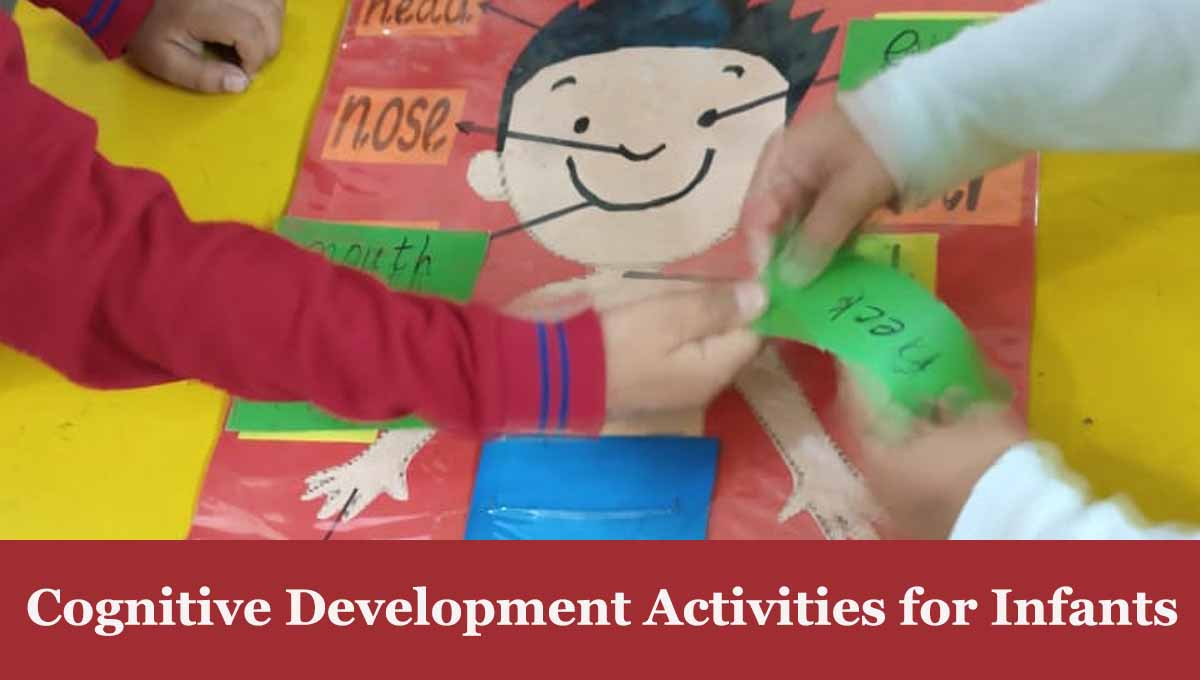
Cognitive Development Activities for Infants 0-12 Months. Cognitive development activities for infants deal with the brain. When we say “cognitive development,” it means the use of the brain or the working of the brain. If a child gives a response, asks questions, shares ideas, speaks, talks, or understands properly, then we can say that the child’s cognitive development is good.
However, if adults give them exposure to their environment, children will use their cognitive skills. The more they use their cognitive skills, the more they will be polished.
Cognitive development activities for infants include simple yet intentional experiences like object permanence games, sensory exploration with natural materials, cause-and-effect toys, visual tracking exercises, language-rich interactions, and movement opportunities that support brain development from birth through 18 months following Montessori principles of self-directed learning.
🌍 More Available Jobs



Now a question arises: What are cognitive skills?
Cognitive skills are problem-solving, critical thinking, reasoning, ordering things, decision-making, creating things, making models, evaluating and finding out conclusions, sequencing, etc.
We should start work on cognitive development from the birth of the child. All think that the newborn child can’t understand us, and we ignore him. We always concentrate on his/her (feeding and sleeping) all physical needs. Although the baby starts to feel and understand when its brain is developed during pregnancy.
Whatever the mother thinks, hears, reads, and watches, all these factors affect her baby’s brain. Being a parent, it’s our responsibility that we should be vigilant about the cognitive development of a child before birth. Mother should perform healthy activities.
🌍 More Available Jobs

Activities for infants (1 to 3 years) are being mentioned below through which we can polish cognitive skills.
In the early years, I would prefer hands-on material instead of worksheets. Because with hands-on experiences, students feel the objects with their hands, and through muscular memory, children save the image or information in their minds, which remains in their minds for the long term. Following are the cognitive development activities for infants.
Building Tower
3 to 5 pieces of tower with different sizes and colors are given to the child to arrange accordingly. This activity will develop hand and eye coordination. And on the side, problem-solving skills, discrimination of sizes and colors, concentration span, and fine motor skills will be catered to. The child will learn from errors. Tower. The child will not be able to make the tower properly until he uses the correct piece. So he will make errors and learn from it. The more they make errors, the more they will use their brains and learn effectively, which affects their cognitive development.
Completing Puzzles
Different types of puzzles are available in the market, e.g., fruit puzzles, birds puzzles, animals puzzles, human body puzzles, transport puzzles, tree puzzles, etc.
Every puzzle has different pieces. So choose puzzles according to the age of your child. As a beginner, a picture of the puzzle is given to the child as a reference. The child will complete the puzzle with the help of the picture. After extensive practice, the child is able to complete the puzzle without a picture.
One more important point is to try to add new and challenging puzzles according to the child’s ability. So that his interest level remains high and he never gets bored.
While completing puzzles, the child thinks from different angles and uses different techniques. Through this process, he learns from experiences and keeps the correct sequence of the puzzle in mind. When he makes the same puzzle 3rd or 4th times, it will be easiest for him. Because patterns of puzzles have been made in his mind.
It can be puzzle apps. Nowadays children use Android apps. There are thousands of puzzles for different levels on the Play Store. However, extensive use of mobile is not good for health.
Sorting Colors
Colors attract children, and they become excited to play with them. Different types of materials are used for sorting colors.
- Students will thread spaghetti in matching colored BBQ sticks. e.g., if the child chooses the red barbecue stick, then the child will thread only red spaghetti.
2: Put small balls of different colors in the appropriate basket that have the same colors.
3: Colorful ice cream sticks will be given for sorting colors. Children can make a collection in colored plates or can make a tower in same color
4: We can use colorful buttons for sorting activities. We can make cutouts of shirts with colorful chart paper, and the child will place buttons according to the shirt color.
This activity will boost the thinking skills of children
Sequencing items or pictures
- We can give them things of different sizes to arrange them according to the sizes.
- We can provide flashcards of the life cycle of a butterfly to place them in sequence according to the life cycle.
Complete Patterns
There are thousands of patterns available in our environment. We can use our household things for patterns. Make your own pattern for your child. He will observe the pattern first, and then they will complete them.
After extensive practice and exposure, children make their own patterns.
In these activities, students’ observational skills are developed.
Describe Pictures
Mostly big storybooks should be used for picture description. This activity enhances a child’s critical thinking. They start to make predictions and draw their conclusion.
I would prefer bedtime stories. It gives peace and calm feelings to your child, and side by side, the child’s mind becomes relaxed. With a relaxed mind, they ask questions.
Ask questions like, “What is happening in this picture?”
Why is he sad/why is she happy?
Use “what,” “when,” “where,” and “how” keywords for descriptions of pictures. Students will share their ideas and feelings. They will find out the solution to problems.
Pick the Odd one out.
This activity enhances the observational skills of a child. He becomes a keen observer. Different types of real objects are placed, and they have to pick one picture out that is different in the group.
Retelling stories
Retelling stories polishes a child’s memory. The child will keep the sequence of the story in mind. He will tell you the whole story according to events.
Sometimes children add their own moments in stories, and from this point their creativity starts.
Find out the difference.
Two objects are given to the students, and they will observe the objects properly and share the difference. In this way, the child thinks about different angles, colors, shapes, materials, designs, and uses. Young children always need help and assistance in the beginning. It depends on adults how they facilitate the thinking process.
Questioning is the key to treasure. The more questions you ask of the child, the more his mind will work.
Building Blocks
Children love to construct buildings or objects with blocks. They create their own designs by using different blocks. They use critical thinking and make different blocks
In short, we should facilitate cognitive development at an early age because the whole personality has been developed during 0-6 years. The speed at which a child can learn at this age will not be able to learn with this speed and quality in the years to come. Therefore, we need to work on it from the beginning. These all are cognitive development activities for infants.
Also Read:
Montessori Activities for 14-Month-Olds
Why is play important for cognitive development in babies?
Young children build their minds through active thinking and deep understanding. Every small movement helps create vital brain-building pathways inside an infant’s head. When you engage in back-and-forth interactions with a newborn, you accelerate their early communication networks. These early moments form the basic structural foundation for all future human learning.
Playing a simple game of peek-a-boo helps a growing child discover object permanence. This simple concept teaches them that things still exist even when hidden from view. This simple game strengthens memory retention while building a strong sense of internal confidence. As they watch you disappear and return, their small minds feel completely safe.
Early problem-solving arises naturally when a curious child encounters a minor physical obstacle. A baby tracking a rolling toy learns about basic cause-and-effect dynamics. This early form of exploratory play triggers the rapid growth of neural synapses. According to research by the Harvard Center, responsive caregiving directly shapes long-term emotional intelligence.
    [Infant Interaction] ──> [Neural Synapse Formation] ──> [Cognitive Milestones]
             │                                                          ▲
             └───────────────> [Secure Attachment & Trust] ─────────────┘
A supportive environment allows a child’s natural curiosity to expand without limits. Sharing joyful moments builds a sense of secure attachment and deep emotional trust. When a parent offers interactive learning experiences, they promote healthy overall mental growth. The AAP emphasizes that learning through play remains essential for child development.
Diverse sensory experiences during the first 1 year of life cultivate lasting curiosity. The first 2 or 3 months focus heavily on basic reciprocal responses. Providing responsive caregiving ensures that cognitive skills develop at an optimal, steady pace. Studies from Stanford show that enriched early childhood education formats boost lifelong spatial awareness.
How cognitive skills develop in babies
Infant growth depends heavily on basic sensory processing and emerging motor coordination. During the first 0-12 months, an infant’s brain rapidly transforms incoming environmental signals. When they handle small household objects, their delicate fine motor skills improve dramatically. These tiny physical movements prepare their small hands for much more complex tasks.
       [0-3 Months]           [4-7 Months]           [8-12 Months]
     Sensory & Vision       Gross Motor Focus       Fine Motor Precision
    (Visual Tracking)      (Rolling & Sitting)     (Pincer Grasp Mastery)
Around 6 months of age, infants expand their physical gross motor skills. They begin sitting upright, rolling over, and reaching for vibrant nearby objects. By 8 months, many infants start demonstrating a coordinated pincer grasp. Using their tiny thumb and forefinger, they can carefully lift minuscule pieces of food.
Mastering visual tracking allows young infants to follow moving objects smoothly across rooms. Meanwhile, auditory localization helps them pinpoint the exact source of unexpected household noises. They quickly connect distinct vocal babbles and soft coos to real emotional outcomes. Using intentional gestures, they tell their caregivers exactly what they need or want.
Babies learn social actions through immediate imitation of your unique facial expressions. They study how you smile, laugh, and move your hands during play. Regular repetition helps them spot predictable patterns in their daily interactive games. This internal predictability creates a soothing routine that supports early memory retention.
An infant’s growing attention span expands through safe, independent trial and error. They learn how parts fit together by testing physical space and spatial awareness. As they grow older, they master basic sequencing and simple mental sorting. Grouping things by color or size introduces early categorization and foundational logic.
[Repeated Action] ──> [Pattern Recognition] ──> [Predictable Memory/Routine]
Using dynamic cause-and-effect toys helps children test how the physical world works. Jean Piaget famously described this active developmental stage as the human sensorimotor stage. Parents must carefully child-proof every room to allow for safe, adventurous exploration. Hitting a major physical milestone gives an infant the freedom to explore their environment.
Between 10 and 12 months, cognitive progress accelerates at an unprecedented rate. A baby begins to realize that their actions cause distinct external reactions. Dropping a spoon from a high chair becomes a fun scientific experiment. They watch it fall to see where it lands and who picks it up.
Play ideas to stimulate baby cognitive development
Daily tummy time serves as the perfect setting for early mental stimulation. Placing vibrant, high-contrast toys just out of reach encourages strong physical neck extension. Infants love shaking bright rattles and tapping small, rhythmic musical instruments. These simple tools keep their minds fully engaged while building core upper body strength.
[Tummy Time Setup] ──> [High-Contrast Object] ──> [Visual Focus & Reach]
Intricate busy boxes and classic jack-in-the-box toys offer wonderful opportunities for learning. Watching a character suddenly pop up teaches babies about hidden physical mechanisms. Stacking colorful stacking blocks and nesting small nesting cups develops hand-eye coordination. Simple shape sorters challenge their growing minds to solve basic geometric puzzles.
Building textured sensory bins allows children to safely explore unique tactile materials. Engaging in supervised water play teaches them about volume, pouring, and liquid splashing. Taking peaceful nature walks exposes their developing senses to rich outdoor sights and sounds. They touch crinkly fallen leaves, green grass, and rough tree bark outdoors.
Introducing diverse physical textures stimulates the tiny nerve endings in an infant’s fingers. Reading sturdy board books and touch-and-feel books builds early pre-literacy skills. Enthusiastic storytelling and simple pretend play foster a highly imaginative young mind. You can use simple everyday household objects to create highly engaging games.
[Household Play] ──> [Wooden Spoons / Metal Whisks] ──> [Acoustic Auditory Discovery]
Handing an infant wooden spoons, metal whisks, or kitchen pots yields surprising sounds. These safe items make wonderful acoustic tools for exploring different volumes and rhythms. Fun bath toys turn regular nightly washing routines into highly educational science sessions. Infants enjoy classic container play where they constantly fill and dump objects.
Playing simple disappearing games keeps an older baby laughing for long periods. Interactive mirror play helps infants recognize their own sweet smiles and body movements. Singing simple singing rhymes with hand gestures introduces them to natural language cadences. Offering safe finger foods gives them a chance to practice self-feeding skills.
Encouraging basic self-care activities builds deep personal independence over a long period. Providing ample space for unstructured movement allows babies to discover their physical boundaries. Parents must offer careful physical guidance along with constant, highly active supervision. Maintaining a completely safe environment ensures their daily play remains joyful and risk-free.
Tailoring activities to specific brackets like 3-6 months ensures ideal developmental tracking. The 6-9 month window shifts focus toward sitting, reaching, and vocalizing. Finally, the 8-12-month phase brings advanced physical exploration and intentional manipulation. Selecting age-appropriate play ideas ensures your baby stays appropriately challenged.
Frequently Asked Questions (Latest Google People Also Ask)
How can I tell if my baby is developing normal thinking skills?
You can observe their daily progress by watching how they interact with objects. A child showing healthy mental growth will focus on bright toys, turn toward distinct sounds, and track moving targets. By the end of their first year, they should look for hidden items and enjoy simple cause-and-effect games.
What types of toys are most effective for improving an infant’s focus?
Toys that require active manual manipulation work best for building concentration. Stacking cups, wooden blocks, simple shape sorters, and texture books keep young minds engaged longer than passive electronic toys. These items encourage self-directed exploration, which extends their natural attention span over time.
Does talking to my newborn really help build their future intelligence?
Yes, constant verbal interaction acts as a primary driver for early brain development. Narrating your daily chores, repeating their soft coos, and reading colorful board books strengthens core language pathways. This responsive verbal bonding helps build the structural foundation for high-level reasoning and vocabulary acquisition.
How does floor play benefit an infant’s spatial awareness?
Spending time on the floor gives babies the physical freedom to explore distance and depth. Reaching for an item just out of reach teaches them how to judge physical space accurately. This unstructured movement helps them understand where their body fits in relation to surrounding household objects.
Conclusion
Intentionally integrating cognitive activities for infants into daily routines accelerates early mental growth. Providing open opportunities for independent exploration helps babies build essential lifelong problem-solving abilities. Responsive parenting turns simple everyday games into deeply meaningful milestones for your growing child.