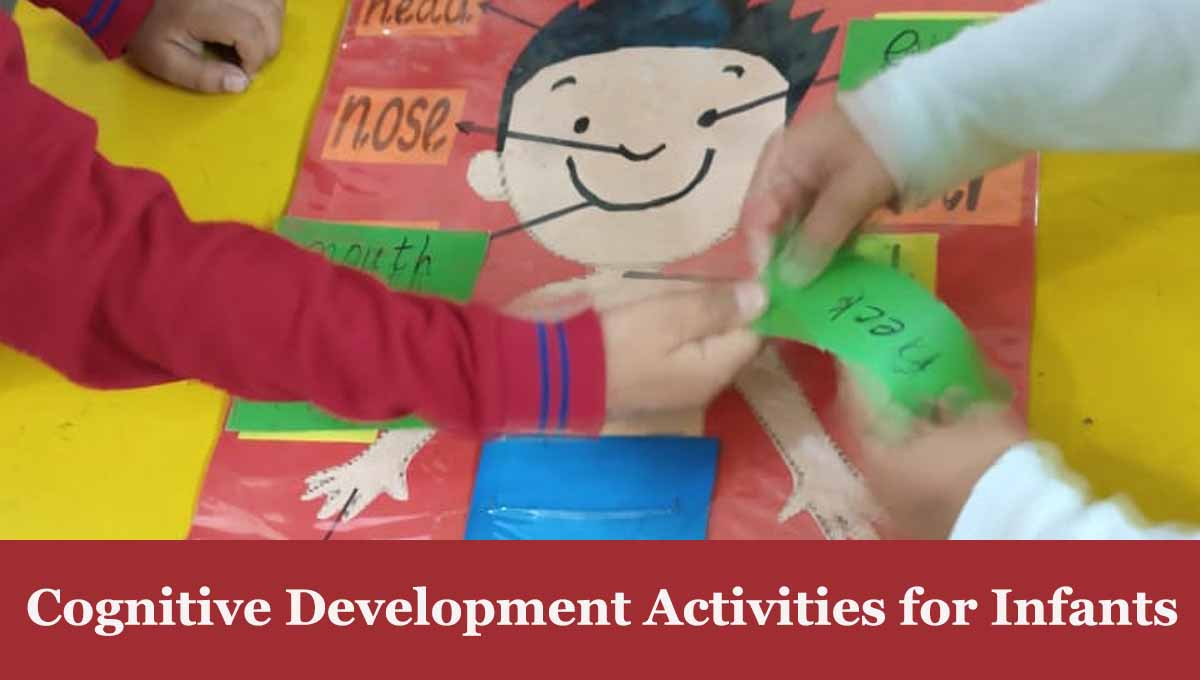
Cognitive development activities for infants deal with the brain. When we say “cognitive development,” it means the use of the brain or the working of the brain. If a child gives a response, asks questions, shares ideas, speaks, talks, or understands properly, then we can say that the child’s cognitive development is good.
However, if adults give them exposure to their environment, children will use their cognitive skills. The more they use their cognitive skills, the more they will be polished.
Cognitive development activities for infants include simple yet intentional experiences like object permanence games, sensory exploration with natural materials, cause-and-effect toys, visual tracking exercises, language-rich interactions, and movement opportunities that support brain development from birth through 18 months following Montessori principles of self-directed learning.
Introduction
Every parent who has watched their infant discover their own hands for the first time or follow a colorful object with wide, curious eyes has witnessed cognitive development in action. These seemingly small moments represent significant neurological milestones that shape how babies understand their world.
In the Montessori approach, cognitive development during infancy isn’t about accelerating learning or creating “super babies.” Instead, it’s about respecting the natural developmental timeline while providing an environment rich with appropriate stimulation. Dr. Maria Montessori recognized that even the youngest children possess an “absorbent mind” capable of extraordinary learning when given the right conditions.
This article explores evidence-based cognitive development activities specifically designed for infants from birth to approximately 18 months. Whether you’re a parent creating a Montessori-inspired nursery, a homeschool educator planning infant activities, or an early childhood professional refining your practice, you’ll find practical, implementable strategies grounded in both Montessori philosophy and contemporary developmental science.
Why This Topic Matters
The first 18 months of life represent a period of unprecedented brain growth. During this window, an infant’s brain creates more than one million neural connections every second. The experiences babies have during this critical period literally shape the architecture of their developing brains.
Research from the Center on the Developing Child at Harvard University confirms what Montessori educators have practiced for over a century: quality interactions and appropriate environmental stimulation during infancy create foundations for all future learning, behavior, and health.
For parents in the United States, Canada, United Kingdom, and Australia, understanding cognitive development activities means:
- Supporting natural learning rhythms rather than forcing academic concepts
- Recognizing developmental milestones and knowing how to facilitate them
- Creating home environments that promote independence and discovery
- Building secure attachments while encouraging exploration
- Preparing children for successful transitions into preschool and kindergarten
Traditional childcare often underestimates infant capabilities, providing either excessive stimulation through electronic devices or insufficient challenge through lack of engagement. The Montessori approach offers a balanced alternative that honors both the infant’s competence and their developmental needs.
Montessori Foundations Related to This Topic
The Absorbent Mind
Dr. Maria Montessori identified the “absorbent mind” as the young child’s unique capacity to absorb information from their environment effortlessly and unconsciously. From birth to age three, infants don’t learn through conscious effort—they absorb experiences directly into their developing neural structures.
This concept transforms how we approach cognitive development activities. Rather than “teaching” infants, we prepare environments where natural learning occurs through everyday experiences.
The Prepared Environment for Infants
In Montessori infant communities (Nido programs), the prepared environment includes:
- Low shelves with carefully selected materials
- Movement areas with freedom to develop gross motor skills
- Visual interest at the infant’s eye level
- Natural materials that engage authentic sensory experiences
- Order and predictability that support cognitive schema development
Sensitive Periods in Infancy
Montessori identified sensitive periods—windows of heightened neurological receptivity to specific types of learning. For infants, key sensitive periods include:
- Order (birth to 4 years): Babies need consistent routines and organized environments
- Movement (birth to 4 years): Physical development directly supports cognitive growth
- Language (birth to 6 years): Infants absorb language structures from their environment
- Sensory refinement (birth to 4 years): Sensory experiences build cognitive categories
Understanding these sensitive periods helps caregivers provide timely, appropriate cognitive activities.
Main Concepts and Explanation
Understanding Infant Cognitive Development
Cognitive development in infancy encompasses several interconnected domains:
Perception: How infants process sensory information from their environment. Newborns can see approximately 8-12 inches clearly (the distance to a caregiver’s face during feeding) and gradually develop visual acuity, depth perception, and color discrimination.
Memory: Initially limited to recognition memory, infants gradually develop recall abilities. By 6 months, most babies demonstrate object permanence—understanding that objects continue to exist even when out of sight.
Problem-solving: Infants develop means-end thinking, learning that specific actions produce desired outcomes. A 10-month-old who pulls a blanket to retrieve a toy demonstrates early problem-solving.
Categorization: Babies naturally organize experiences into categories. By 6 months, infants can categorize objects by color, shape, and even more abstract concepts like “things that move.”
Imitation: From birth, infants demonstrate remarkable imitative abilities, which become increasingly sophisticated throughout the first year.
Piaget’s Sensorimotor Stage
Developmental psychologist Jean Piaget identified the sensorimotor stage (birth to 2 years) as the foundation of cognitive development. Infants in this stage learn primarily through sensory experiences and motor actions.
Piaget divided this stage into six substages:
- Reflexive schemes (birth-1 month): Learning through reflexes
- Primary circular reactions (1-4 months): Repeating pleasurable actions
- Secondary circular reactions (4-8 months): Repeating actions that produce interesting environmental effects
- Coordination of secondary schemes (8-12 months): Intentional, goal-directed behavior
- Tertiary circular reactions (12-18 months): Experimentation through trial and error
- Mental representation (18-24 months): Beginning symbolic thought
Montessori activities align beautifully with these natural developmental progressions.
The Role of Executive Function
Even in infancy, the foundations of executive function begin developing. Executive function includes:
- Working memory: Holding information temporarily
- Inhibitory control: Managing impulses and attention
- Cognitive flexibility: Adjusting to changing circumstances
Simple activities like waiting for a caregiver to return (peek-a-boo), reaching for an object, or switching attention between two interesting items all build early executive function capacities.
Age-Appropriate Cognitive Development Activities
Birth to 3 Months: Sensory Awareness and Visual Tracking
During the first three months, cognitive activities focus on sensory integration and establishing attentional patterns.
Visual Tracking Activities:
- Montessori mobiles: Use the sequence of Munari, Octahedron, Gobbi, and Dancers mobiles placed 12-16 inches above where the baby lies. These mobiles provide appropriate visual complexity and support tracking skills.
- Face-to-face interaction: Position your face within the infant’s visual range and slowly move side to side, encouraging tracking.
- High-contrast images: Simple black-and-white patterns support developing visual systems.
Auditory Development:
- Responsive conversation: Speak to your infant during care routines, describing actions and responding to vocalizations.
- Music and sound exploration: Gentle, live singing supports language processing more effectively than recorded music.
- Environmental sounds: Allow infants to hear natural household sounds rather than constant white noise.
Tactile Experiences:
- Skin-to-skin contact: Supports regulation and sensory integration.
- Varied textures during care: Use different fabric textures during dressing and bathing.
- Gentle massage: With appropriate oil, gentle infant massage provides tactile input and supports body awareness.
3 to 6 Months: Reaching, Grasping, and Cause-Effect
As motor control improves, cognitive activities become more interactive.
Object Exploration:
- Grasping materials: Provide lightweight wooden rattles, natural rubber rings, and fabric balls that infants can grasp and explore.
- Treasure basket exploration: A basket filled with safe household objects (wooden spoon, metal whisk, natural sponge, silk scarf) allows open-ended exploration.
- Montessori interlocking discs: Two wooden rings connected allow infants to practice transferring objects from hand to hand.
Cause-and-Effect Activities:
- Kick toys: Suspend a bell or soft object where the infant can kick it while lying on their back, demonstrating that their actions produce effects.
- Sound-making objects: Rattles, bells, and crinkly fabrics teach that actions create sounds.
- Responsive toys: Simple push toys that move or make sounds when manipulated.
Language and Social Cognition:
- Narrated care routines: Describe every step during diaper changes, feeding, and dressing.
- Picture books: High-contrast board books with simple images support visual processing and vocabulary development.
- Mirror play: Allow supervised tummy time near a floor mirror, supporting self-awareness and visual tracking.
6 to 9 Months: Object Permanence and Intentionality
This period marks significant cognitive leaps, particularly in understanding object permanence and developing intentional actions.
Object Permanence Activities:
- Peek-a-boo variations: Cover your face with a cloth, then remove it. Progress to covering objects for the infant to uncover.
- Ball in cup: Drop a ball into a cup and let the infant retrieve it.
- Partially hidden objects: Place a toy partially under a cloth, encouraging the infant to pull it out.
- Montessori object permanence box: A box with a hole on top and a drawer at the bottom where a ball disappears and reappears.
Container Play:
- In-and-out activities: Provide containers and safe objects for infants to practice putting in and taking out.
- Nested cups: Two or three sizes of cups that fit inside each other.
- Basket emptying: Fill a basket with interesting objects for the infant to remove one by one.
Early Problem-Solving:
- Barrier games: Place a transparent barrier (like acrylic) between the infant and a desired toy, encouraging problem-solving.
- Pulling cloths: Place a toy on a small cloth just out of reach, demonstrating that pulling the cloth brings the toy closer.
9 to 12 Months: Means-End Behavior and Early Categorization
Cognitive development accelerates as infants demonstrate increasingly sophisticated problem-solving.
Advanced Object Permanence:
- Montessori egg in cup: An egg that fits into a cup, teaching object permanence and one-to-one correspondence.
- Multiple hiding places: Hide an object under one of three cups, encouraging the infant to remember and search.
- Drop box: A box with various-shaped holes where objects can be dropped through.
Early Spatial Reasoning:
- Stacking rings: A post with 2-3 large rings to stack (save smaller rings and ordering by size for later).
- Simple posting boxes: Boxes with one large hole for posting cylindrical objects.
- Shape sorters: Begin with one or two very different shapes (circle and square).
Imitation and Social Learning:
- Action songs: “Pat-a-cake” and similar games teach imitation and sequence.
- Tool use imitation: Allow infants to observe and imitate simple actions like stirring with a spoon.
- Household participation: Include infants in simple tasks like wiping a table with a cloth.
Language Development Activities:
- Naming objects: Point to and name objects throughout the day.
- Montessori language baskets: Collections of real objects grouped by category (animals, vehicles, household items).
- Picture-object matching: Show pictures alongside real objects.
12 to 18 Months: Symbolic Thinking and Advanced Problem-Solving
The transition from infancy to toddlerhood brings emerging symbolic thought and more complex cognitive abilities.
Advanced Problem-Solving:
- Montessori imbucare boxes: Various boxes with different-shaped openings requiring specific problem-solving strategies.
- Simple puzzles: Single-piece puzzles with knobs (geometric shapes or simple animals).
- Nesting and stacking: Graduated cups, boxes, or rings ordered by size.
Early Math Concepts:
- One-to-one correspondence: Place one object in each container, one napkin at each place setting.
- Emptying and filling: Transferring activities using larger objects and containers.
- Grouping similar objects: Sorting activities with very different categories (balls vs. blocks).
Symbolic Play Foundations:
- Realistic play objects: Simple wooden animals, vehicles, or dolls that represent real things.
- Pretend feeding: Offering a doll a cup or spoon.
- Care activities: Simple versions of real activities like sweeping or watering plants.
Language Explosion Support:
- Rich vocabulary exposure: Name everything, using precise language (“cardinal” not just “bird”).
- Simple books: Stories with clear, simple narratives and realistic illustrations.
- Following simple directions: “Please bring me the ball” or “Put the book on the shelf.”
Montessori Education in the United States
Montessori education has experienced significant growth in the United States over the past two decades. According to the National Center for Montessori in the Public Sector, there are now over 500 public Montessori programs serving approximately 150,000 students, in addition to thousands of private Montessori schools.
For infant programming specifically, Montessori Nido (nest) programs are becoming increasingly available, particularly in metropolitan areas. These programs typically serve infants from approximately 2-3 months through 12-15 months, before transitioning to infant community programs.
Trends in American Montessori Infant Programs:
- Growing recognition of infant competence and agency
- Increased parent interest in attachment-based, responsive care models
- Integration of Montessori principles with RIE (Resources for Infant Educarers) approaches
- Emphasis on minimizing screen time and electronic toys
- Focus on natural materials and sustainable practices
American parents researching cognitive development activities increasingly discover Montessori through social media platforms, where hashtags like #montessoriathome and #montessoribaby have created communities sharing ideas and experiences.
Regional Availability:
Montessori infant programs are most prevalent in California, New York, Massachusetts, Texas, and Colorado. However, availability varies significantly, with urban areas offering more options than rural communities. This disparity has increased interest in Montessori homeschool approaches for infant care.
The American Montessori Society (AMS) provides credentials specifically for infant-toddler educators and maintains directories of affiliated programs throughout the country. Many American Montessori schools also offer parent-infant classes where families can learn age-appropriate activities and Montessori principles.
Montessori Education in Canada
Canadian Montessori education has developed robust standards through the Canadian Council of Montessori Administrators (CCMA), which accredits schools and provides professional development.
Infant Montessori programs in Canada often emphasize:
- Bilingual or multilingual language exposure (particularly English-French in many regions)
- Connection to nature and outdoor exploration, even for very young infants
- Indigenous perspectives on child development and attachment
- Provincial childcare standards integrated with Montessori philosophy
Provincial Variations:
In British Columbia and Ontario, where Montessori has a particularly strong presence, infant programs often incorporate provincial early learning frameworks alongside Montessori principles. Quebec’s subsidized childcare system has created unique opportunities for accessible Montessori infant care.
Canadian parents increasingly seek cognitive development activities that work in smaller urban living spaces. This has led to creative adaptations of Montessori principles for apartment living, with emphasis on rotating materials and maximizing vertical space.
The Montessori Foundation of Canada provides resources specifically tailored to Canadian families, including guidance on selecting appropriate materials and creating Montessori spaces within diverse housing situations.
Montessori Education in the United Kingdom
Montessori education in the UK has a long-established presence, with the Montessori St. Nicholas Charity providing training and support since 1954. The Montessori Schools Association accredits programs and maintains standards.
UK-Specific Considerations:
British Montessori infant programs must align with the Early Years Foundation Stage (EYFS) framework while maintaining Montessori principles. This integration has created distinctive practices:
- Key person assignments that support attachment relationships
- Documentation and observation practices that meet EYFS requirements
- Emphasis on outdoor learning regardless of weather
- Integration of Montessori approaches with British childcare traditions
UK parents often discover Montessori cognitive development activities through National Childbirth Trust (NCT) networks and parent-baby groups. There’s particular interest in Montessori approaches that support independent sleep, feeding transitions, and weaning (baby-led weaning aligns well with Montessori philosophy).
The cost of childcare in the UK makes Montessori homeschool approaches particularly appealing for infant care, with parents using Montessori principles while keeping infants at home before preschool entry.
Montessori Education in Australia
Australian Montessori has grown significantly, with Montessori Australia providing national standards and professional development. The country has developed distinctive approaches to infant Montessori education.
Australian Characteristics:
- Strong emphasis on outdoor environments and nature connection from infancy
- Integration with Aboriginal and Torres Strait Islander perspectives on child-rearing
- Alignment with the Early Years Learning Framework (EYLF)
- Particular focus on respectful care practices during nappy changes, feeding, and transitions
Australian Montessori infant programs often feature extensive outdoor spaces where even young babies can experience natural environments safely. The climate in many regions allows year-round outdoor activities that support cognitive development through nature exploration.
State-by-State Variations:
Victoria and New South Wales have the highest concentration of Montessori infant programs, though availability is growing in Queensland and Western Australia. Adelaide and Melbourne particularly have strong Montessori communities with active parent education programs.
Australian parents often combine Montessori principles with other local approaches like the Possums sleep and settling program, creating hybrid practices that maintain Montessori respect for the child while addressing practical parenting challenges.
Montessori vs Traditional Education
| Aspect | Montessori Approach | Traditional Approach |
|---|---|---|
| Environment | Prepared environment with child-sized furniture, accessible materials at infant eye level, freedom of movement | Adult-centered spaces, cribs and containers that restrict movement, toys stored out of reach |
| Materials | Natural materials (wood, metal, fabric, wicker), aesthetically beautiful, specific purposes | Plastic toys, electronic devices, bright primary colors, multifunctional entertainment items |
| Caregiver Role | Observer and facilitator, responds to infant cues, supports independence | Director of activities, entertains infant, focuses on keeping baby happy and occupied |
| Daily Structure | Predictable routines with flexibility, infant helps determine schedule based on natural rhythms | Adult-determined schedule, activities planned for infant convenience or curriculum requirements |
| Cognitive Activities | Self-directed exploration, real experiences with real objects, movement integrated with learning | Adult-led activities, educational toys, separation of learning from daily life |
| Language Development | Rich, precise vocabulary during authentic interactions, no baby talk | Simplified language, frequent use of diminutives, conversation separate from care routines |
| Learning Goals | Support natural development, build concentration and independence, follow the child | Achieve milestones, teach specific skills, accelerate development |
| Parent/Caregiver Relationship | Partnership, parent education emphasized, observations shared | Expert-parent dynamic: professionals direct parent behavior |
Cognitive Development Progression: Montessori vs Traditional
| Age | Montessori Focus | Traditional Focus |
|---|---|---|
| 0-3 months | Visual tracking with appropriate mobiles, sensory integration through natural care routines, establishing attachment | Tummy time, colorful toys, developmental milestones, keeping baby entertained |
| 3-6 months | Reaching and grasping natural materials, cause-effect exploration, beginning object permanence games | Propping to sit, exersaucers, activity mats, rattles and teethers |
| 6-9 months | Intentional movement, container exploration, object permanence boxes, early problem-solving | Supported standing, walker toys, electronic learning toys, baby classes |
| 9-12 months | Means-end thinking, early spatial reasoning, imitation of practical life, language baskets | Walking assistance, shape sorters, stacking toys, educational videos |
| 12-18 months | Symbolic thinking, advanced problem-solving, practical life participation, precise language | Interactive toys, app-based learning, structured classes, early academics |
Real-World Examples
Example 1: Morning Routine with 8-Month-Old Sophie
Rachel, a stay-at-home parent in Toronto, transformed her morning routine into rich cognitive development opportunities:
“Instead of quickly dressing Sophie on the changing table while she fusses, I slow down and make it collaborative. I hold up her shirt and say, ‘Here’s your armhole.’ Can you push your arm through?’ She’s learned to actively participate. I describe each step: ‘Now I’m buttoning the three buttons—one, two, three.’
After dressing, Sophie practices pulling up on a low bar near her floor bed. I don’t hover, just stay nearby. She’s working on problem-solving—how to get her body upright. Yesterday, she figured out that turning her feet helps her balance.
Breakfast has become a cognitive activity too. Sophie sits in a weaning chair at a low table. She has a small cup with a little water and practices drinking. She’s learning spatial awareness, cause-effect (tipping the cup makes water come out), and fine motor control. Yes, there’s a mess, but she’s learning so much more than if I just held a sippy cup for her.”
Example 2: Montessori Homeschool with Three Children
James and Patricia in rural Queensland homeschool their three children, including 14-month-old Oliver:
“We have limited space and budget, so I’ve gotten creative with Montessori principles. Oliver’s ‘classroom’ is a corner of our living area with a low shelf I made from repurposed wood. It holds five activities that I rotate weekly:
Currently, he has a basket with three wooden animals, a simple posting box I made from a shoebox and cardboard tube, a fabric book, wooden rings on a post, and a treasure basket with kitchen items.
Oliver’s older siblings (ages 4 and 6) sometimes want to ‘teach’ him, but I’ve shown them how to model activities instead. Yesterday, our 4-year-old showed Oliver how to drop blocks into a container. Oliver watched intently, then tried himself. That’s real cognitive development—observing, imitating, practicing.
Our outdoor area has become essential. Oliver explores textures (grass, dirt, leaves), practices walking on uneven ground, and investigates insects. These natural experiences support cognitive development as much as any expensive material.”
Example 3: Montessori Preschool Infant Community
Laura, an infant-toddler guide at a Montessori school in Massachusetts, describes her classroom:
“We serve eight infants ages 3-15 months with two teachers. Our prepared environment includes distinct movement areas, feeding areas, sleeping areas, and work areas.
For cognitive development, we focus on following each child’s interests. Ten-month-old Aiden became fascinated with opening and closing boxes. Rather than redirect him to the ‘planned’ activity, I observed what captivated him and introduced progressively challenging boxes—first a simple hinged lid, then a sliding lid, then a box with a simple latch.
Twelve-month-old Maya showed readiness for object permanence work. We introduced the Montessori ball drop box. Initially, she needed help understanding that the ball that disappeared on top would reappear in the drawer below. After three weeks of choosing this work almost daily, you can see the recognition on her face—she’s grasped this cognitive concept.
We also bring real life into the classroom. When it’s time to set up lunch, older infants help place napkins at each spot. This one-to-one correspondence is early math. They’re not just learning a task—they’re developing cognitive structures.”
Example 4: Parent Education Class Transformation
Melissa in London attended a parent-infant Montessori class when her daughter Emma was 5 months old:
“I thought I needed to constantly entertain Emma with toys, songs, and activities. The Montessori instructor helped me see that I was actually interrupting Emma’s natural cognitive development.
She taught us to observe before intervening. I watched Emma focus intently on her own hand for nearly ten minutes—opening and closing her fingers, turning her hand in different directions, bringing it to her mouth. Previously, I would have interrupted with a toy or song, thinking she was bored.
The class introduced simple materials like the Montessori interlocking discs—just two wooden rings connected. Emma practiced passing them from hand to hand, working on this for weeks. It seemed too simple to me, but the instructor explained Emma was developing bilateral coordination, object manipulation, and concentration—all cognitive skills.
Most importantly, I learned to trust Emma’s natural learning drive. I don’t need to teach her constantly. I need to prepare an appropriate environment and step back.”
Benefits
For Infant Development:
- Supports natural cognitive progression without forcing or accelerating development
- Builds strong neural connections through multisensory experiences
- Develops concentration and focus from early months
- Encourages problem-solving and independent thinking
- Integrates cognitive, physical, and social-emotional development
- Respects individual developmental timelines and interests
- Creates foundations for executive function skills
- Promotes intrinsic motivation rather than external reward systems
For Parents and Caregivers:
- Provides clear framework for understanding infant cognitive development
- Reduces anxiety about “doing enough” to stimulate development
- Offers concrete activities that don’t require expensive materials
- Builds observation skills that deepen understanding of individual child
- Creates opportunities for meaningful interaction during daily routines
- Supports attachment through responsive, respectful engagement
- Reduces reliance on screens and electronic devices
- Aligns daily life with developmental support
For Family Dynamics:
- Involves siblings meaningfully in infant care
- Creates calmer home environment with reduced overstimulation
- Establishes routines that support all family members
- Builds family culture of respect and independence
- Reduces consumer spending on unnecessary infant products
- Provides conversation topics and shared language with other Montessori families
Long-Term Educational Benefits:
- Prepares infants for successful Montessori preschool transition
- Builds self-directed learning habits
- Develops attention span and persistence
- Creates foundations for mathematical and scientific thinking
- Establishes language-rich environment supporting literacy
- Encourages curiosity and love of learning
Challenges
Material Access and Cost:
- Authentic Montessori infant materials can be expensive
- Not all families have access to Montessori suppliers
- DIY alternatives require time and skill to create
- Limited options in rural or remote areas
Space Limitations:
- Urban apartments may lack space for prepared environments
- Shared living situations complicate material organization
- Safe movement areas challenging in smaller homes
- Storage of rotating materials requires planning
Cultural and Family Resistance:
- Extended family may question approach or offer conflicting advice
- Cultural childcare practices may differ from Montessori principles
- Grandparents and caregivers may need education and support
- Peer pressure from other parenting communities
Time and Patience Requirements:
- Observing rather than directing requires patience
- Preparing and maintaining environment takes time
- Following the child’s pace may feel slow
- Explaining approach to skeptical family members requires effort
Information Overload:
- Conflicting advice from various Montessori sources
- Social media creates comparison and inadequacy
- Difficulty distinguishing authentic Montessori from Montessori-inspired
- Overwhelming amount of available activities and materials
Developmental Concerns:
- Difficulty knowing when to intervene vs. observe
- Anxiety when infant doesn’t show interest in prepared materials
- Concerns when development differs from other children
- Balancing Montessori principles with medical advice
Practical Implementation:
- Maintaining order and rotation with busy schedules
- Integrating approach with childcare providers unfamiliar with Montessori
- Adapting activities for infants with special needs or developmental delays
- Managing mess and cleaning associated with exploration
Common Mistakes Parents Make
Mistake 1: Overstimulating the Environment
The Problem: Parents fill the infant’s space with too many materials, bright colors, electronic toys, and constant entertainment.
Why It Happens: Cultural messaging suggests more stimulation produces smarter babies. Parents worry their infant will be “bored.”
The Solution: Limit materials to 4-6 options at a time. Choose neutral, calming colors for the environment. Rotate materials weekly rather than presenting everything simultaneously. Remember that infants need processing time and rest, not constant stimulation.
Real Example: Instead of a playroom filled with dozens of toys, create a small shelf with five carefully selected materials. Notice how much longer your infant engages with each item when choices are limited.
Mistake 2: Interrupting Concentration
The Problem: When infants focus intently on an activity, parents interrupt with “helpful” suggestions, new toys, or praise.
Why It Happens: We don’t recognize deep concentration in infants or feel uncomfortable with silence.
The Solution: Practice observation without intervention. When your infant is engaged with a material, step back and simply watch. Resist the urge to show them the “right” way or introduce new elements. Let them work to their own natural conclusion.
Real Example: Your 9-month-old repeatedly takes objects from a basket and puts them back in. This may seem pointless to you, but she’s building cognitive schemas about containers, in-and-out relationships, and object permanence. Don’t interrupt with “Now let’s try stacking!” until she’s clearly finished.
Mistake 3: Using Baby Talk Exclusively
The Problem: Parents use simplified vocabulary, sound effects, and baby talk rather than rich, precise language.
Why It Happens: Baby talk feels natural, and we believe infants can’t understand complex language.
The Solution: Speak to your infant using rich, precise vocabulary. Name objects accurately (“cardinal,” not just “birdie”). Describe actions during care routines. Use complete sentences. You can use a warm, affectionate tone without simplifying language.
Real Example: During diaper changes, instead of “Let’s change your diaper,” try “I’m going to unfasten these three snaps.” Can you feel the cool wipe on your skin? Now I’m putting on your fresh diaper and fastening the snaps again—one, two, three.”
Mistake 4: Not Allowing Enough Freedom of Movement
The Problem: Infants spend excessive time in containers (swings, bouncers, carriers, car seats) that restrict natural movement.
Why It Happens: Containers seem convenient and safe. Parents may not understand the importance of movement for cognitive development.
The Solution: Provide extensive floor time from birth. Use a firm mat or blanket on the floor rather than propping the infant in seated positions before they can achieve them independently. Let infants work through movement challenges without immediately helping.
Real Example: Rather than placing your 6-month-old in a sitting position (which they cannot yet achieve alone), allow them floor time where they can work toward rolling, pivoting, and eventually sitting independently. This problem-solving builds cognitive pathways.
Mistake 5: Expecting Performance or Demonstrations
The Problem: Parents ask infants to “show grandma” what they learned or feel disappointed when infants don’t interact with materials as expected.
Why It Happens: We view activities as teaching specific skills rather than supporting natural development.
The Solution: Release expectations about how infants “should” use materials. If your infant mouths the shape sorter instead of posting shapes, that’s developmentally appropriate exploration. Trust the process rather than focusing on outcomes.
Real Example: You introduce the object permanence box, but your 10-month-old is more interested in opening and closing the drawer than dropping the ball through the hole. This is perfect—he’s exploring the component that interests him and building cognitive understanding.
Mistake 6: Comparing Development to Other Infants
The Problem: Parents worry because their infant isn’t doing what another infant the same age is doing.
Why It Happens: Social media and parent groups create constant comparison opportunities.
The Solution: Remember that normal development spans a wide range. Focus on your individual infant’s progress over time rather than comparing it to others. Trust the Montessori principle of following the child.
Real Example: Your friend’s 11-month-old is walking, while yours is contentedly crawling and cruising. Both are normal. Your child might be focusing cognitive energy on language development or fine motor skills instead.
Mistake 7: Buying Too Many Commercial “Educational” Toys
The Problem: Parents purchase expensive electronic toys marketed as educational rather than providing simple, open-ended materials.
Why It Happens: Marketing convinces parents that specific products will boost intelligence.
The Solution: Focus on simple, natural materials and real objects. A wooden spoon and metal bowl provide more cognitive development opportunity than most electronic toys. Many of the best materials cost little or nothing.
Real Example: Instead of a $50 electronic learning toy, offer a basket containing real items: a small whisk, a natural sponge, a wooden clothespin, a metal measuring cup, and a piece of wool felt. Your infant will explore extensively and build real understanding.
Expert Tips
Tip 1: Perfect Your Observation Skills
Develop the practice of watching without intervening. Set a timer for 10 minutes and simply observe your infant without redirecting, helping, or teaching. Notice what captures their attention, how they approach problems, and when they signal for help vs. working independently.
Keep a simple observation journal. Jot down what materials your infant chooses, how long they engage, and what skills you notice developing. Over time, patterns emerge that guide your environment preparation.
Tip 2: Narrate Care Routines
Transform every diaper change, feeding, dressing, and bathing into a language-rich cognitive activity. Describe what you’re doing, name body parts, count steps, and explain processes. This turns necessary care into valuable learning time.
Use the three-period lesson approach from Montessori: “This is your foot” (naming), “Where is your foot?” (recognition), and “What is this?” (recall). This systematic language introduction supports cognitive development.
Tip 3: Create a Rotation System
Organize materials in storage boxes labeled by category or developmental focus. Every 5-7 days, remove current materials from the shelf and replace with new selections. Store the removed materials away for at least two weeks before reintroducing.
This rotation maintains novelty without overwhelming the infant, supports sustained engagement, and maximizes the use of limited materials. Take photos of shelf arrangements to remember successful combinations.
Tip 4: Integrate Learning Into Daily Life
Rather than separating “learning activities” from daily life, integrate cognitive development into everything. Let your infant participate in meal preparation, laundry sorting, plant watering, and household tasks at their level.
This approach teaches that learning happens continuously, not just during designated “educational” times. It also builds practical life skills while supporting cognitive development.
Tip 5: Prioritize Order and Predictability
Infants in their sensitive period for order need consistent routines and organized environments to build cognitive schemas. Maintain predictable schedules for eating, sleeping, and activities. Return materials to the same place on the shelf each time.
This external order helps infants develop internal organization—the foundation for categorization, memory, and logical thinking.
Tip 6: Choose Quality Over Quantity
Select a few well-made materials of natural substances rather than many plastic toys. A single beautiful wooden rattle will be used more extensively than a dozen cheap plastic ones. Quality materials invite deeper engagement and provide authentic sensory experiences.
Consider materials investments carefully. One excellent Montessori material that your infant uses for months provides better value than multiple items used briefly or not at all.
Tip 7: Follow Interest Over Curriculum
If your infant shows intense interest in containers, provide multiple container experiences rather than moving on to the “next” activity in a curriculum. Following the child’s interests produces deeper learning than following predetermined sequences.
Be flexible and responsive. The prepared environment is a hypothesis you test through observation and adjust based on your infant’s actual engagement.
Tip 8: Build a Montessori Community
Connect with other Montessori families online or in person. Join local parent-infant classes, online forums, or social media groups. This community provides support when you question your approach, ideas when you feel stuck, and encouragement when you face criticism.
Many cities have Montessori parent groups that meet regularly. If none exists in your area, consider starting one or connecting virtually with parents in other regions.
Tip 9: Address Special Needs Thoughtfully
If your infant has developmental delays, physical challenges, or other special needs, Montessori principles still apply but may require adaptations. Work with therapists and specialists to modify materials and environments while maintaining Montessori respect for the child.
The Montessori emphasis on following the individual child makes it naturally adaptive to diverse needs. Focus on your specific infant’s current abilities and interests rather than age-based expectations.
Tip 10: Practice Patience and Trust
Perhaps the most important tip: trust your infant’s natural drive to learn. You don’t need to create learning—you need to prepare an environment where it can unfold naturally. When you feel anxious about “doing enough,” take a breath and remember that your responsive presence matters more than perfect activities.
Development happens on individual timelines. Your observation, respect, and thoughtful preparation will support your infant’s cognitive growth more effectively than any forced teaching.
Latest Montessori Trends in 2026
Technology Boundaries in Infant Care
The Montessori community has responded to the American Academy of Pediatrics’ continued recommendations against screen time for infants under 18-24 months with a strengthened emphasis on screen-free environments. The 2025 research linking early screen exposure to attention difficulties has accelerated this trend.
Many Montessori programs now include explicit technology policies for infants, and parent education increasingly addresses managing family screen use when infants are present.
Sustainability and Natural Materials
Environmental consciousness has elevated Montessori’s traditional preference for natural materials. Families increasingly seek sustainable, plastic-free options for infant materials. Companies producing Montessori materials now emphasize sustainably sourced wood, natural fibers, and non-toxic finishes.
The second-hand Montessori material market has grown significantly, with parents buying, selling, and swapping materials to reduce environmental impact and cost.
Outdoor Infant Environments
Inspired by Scandinavian practices and supported by research on nature’s benefits for development, Montessori programs increasingly create outdoor spaces specifically designed for infants. Even young babies spend substantial time outdoors, experiencing natural light, temperature variations, and diverse sensory input.
Home-based Montessori families are creating outdoor infant areas with safe ground-level exploration spaces, natural materials, and shade structures.
Neuroscience Integration
Montessori educators increasingly reference neuroscience research that validates practices Dr. Montessori identified through observation a century ago. Parent education now commonly includes information about brain development, neural plasticity, and the neuroscience of attachment.
This scientific validation has helped Montessori gain credibility with parents who might otherwise view it as outdated or overly alternative.
Respectful Care Practices
Influenced by Magda Gerber’s RIE approach and Emmi Pikler’s research, Montessori infant programs have deepened emphasis on respectful care during routines. Slow, narrated care that invites infant participation is now central to Montessori infant practice.
This includes never moving an infant’s body without warning, always explaining what’s happening during care, and waiting for infant cooperation rather than forcing compliance.
Minimalist Montessori
A counter-trend to consumer culture, minimalist Montessori emphasizes fewer, carefully selected materials over abundant options. Families create beautiful, uncluttered spaces with limited, rotating materials.
Social media accounts featuring minimalist Montessori environments have influenced parents to question whether they need all the materials they see marketed and to focus on essentials.
Inclusive and Culturally Responsive Practices
The Montessori community is actively working to make infant programs more culturally inclusive and responsive. This includes:
- Materials reflecting diverse family structures and cultural backgrounds
- Acknowledgment of varied cultural practices around infant care
- Addressing the historically white, privileged demographics of Montessori programs
- Creating scholarship and accessibility programs for families from underrepresented communities
Parent Partnership Models
Rather than expert-directed parent education, many Montessori infant programs now emphasize partnership models where parents and educators collaborate as co-experts on the individual child. This respects parents’ deep knowledge of their child while providing Montessori expertise.
Parent education programs are increasingly interactive, with observation opportunities and guided practice rather than lecture formats.
Integration with Attachment Science
Montessori infant practice increasingly integrates attachment research, emphasizing that secure attachment relationships form the foundation for all cognitive and social-emotional development. Programs focus on consistency of caregivers, responsive care, and supporting parent-infant bonding.
Some programs now include attachment-focused parent support, recognizing that supporting the parent-child relationship may be as important as providing quality infant care.
Best Montessori Resources for Parents
Books
“The Montessori Baby” by Simone Davies and Junnifa Uzodike
Comprehensive guide to Montessori principles from birth through age one, with practical activities and beautiful illustrations. Excellent for parents new to Montessori.
“The Joyful Child: Montessori, Global Wisdom for Birth to Three” by Susan Mayclin Stephenson
Deep exploration of Montessori infant-toddler philosophy with global perspectives on child-rearing.
“Understanding the Human Being” edited by Silvana Montanaro
Based on Dr. Montanaro’s AMI lectures, this book provides detailed information about infant development from a Montessori perspective, including prenatal through age three.
“Montessori from the Start” by Paula Polk Lillard and Lynn Lillard Jessen
Covers birth through age three with detailed explanations of Montessori philosophy and practical application in home settings.
“How to Raise an Amazing Child the Montessori Way” by Tim Seldin
Accessible introduction with activities organized by age and developmental area, including many infant activities.
Organizations
American Montessori Society (AMS)
Provides school directories, teacher credential information, parent resources, and annual conferences. Their website includes articles on infant development and Montessori principles.
Website: amshq.org
Montessori Accreditation Council for Teacher Education (MACTE)
Accredits Montessori teacher education programs. Their site helps parents understand authentic Montessori credentials and find qualified programs.
Website: macte.org
Association Montessori Internationale (AMI)
The organization founded by Dr. Montessori, maintaining standards for Montessori education worldwide. Offers parent education courses and resources.
Website: montessori-ami.org
International Montessori Council (IMC)
Provides accreditation, professional development, and resources for Montessori educators and parents.
Website: montessori-imc.org
Montessori Australia
National organization providing resources, school directories, and parent information specific to Australian Montessori families.
Website: montessoriaustralia.org.au
Montessori Europe
European organization connecting national Montessori societies and providing resources for European families.
Website: montessori-europe.com
Learning Materials
Nienhuis Montessori
Premium Montessori materials manufacturer producing authentic, AMI-approved materials including infant mobiles and materials.
Monti Kids
Subscription service delivering developmentally appropriate Montessori materials with parent education content, organized by child’s age.
Lovevery
Play kit subscription incorporating Montessori principles with research-based materials for infants and toddlers.
Bannor Toys
American company producing beautiful wooden Montessori-aligned toys and materials at moderate prices.
Bella Luna Toys
Canadian retailer specializing in natural, Montessori-aligned materials with excellent customer service.
Montessori Outlet
Affordable Montessori materials with infant-toddler section, good for families building collections on limited budgets.
Online Resources
Montessori in Real Life (montessoriinreallife.com)
Blog and Instagram by Nicole Kavanaugh providing practical Montessori infant activities and home setup ideas.
The Montessori Notebook (themontessorinotebook.com)
Comprehensive resource with articles, activity ideas, and guides for implementing Montessori at home with infants through elementary ages.
The Montessori Room (themontessoriroom.com)
Minimalist Montessori approach with room setup ideas, material recommendations, and philosophy discussions.
How We Montessori (howwemontessori.com)
Australian Montessori parent blog with extensive infant and toddler activity ideas, material reviews, and home setup inspiration.
Child of the Redwoods
Instagram account and blog (@childoftheredwoods) featuring beautiful Montessori infant environments and activities with detailed explanations.
Montessori Nature (montessorinature.com)
Blog by Kari Kubiszyn Schaefer focused on nature-based Montessori activities, including many appropriate for infants.
Parent Education Programs
Parent-Infant AMI Course
Association Montessori Internationale offers courses specifically for parents of children birth to three, available in various locations internationally.
Montessori Parent (montessoriparent.com)
Online parent education platform with courses on Montessori principles for different age groups, including comprehensive infant content.
Montessori for Everyone
Digital albums and courses for parents and educators implementing Montessori at home or in schools, with infant-toddler level materials.
Frequently Asked Questions
What are the best cognitive development activities for newborns?
For newborns (0-3 months), cognitive development focuses on sensory integration and establishing basic patterns of attention. The best activities include:
- Montessori visual mobiles (Munari, Octahedron, Gobbi, and Dancers in sequence)
- Face-to-face interaction during alert periods
- Narrated care routines that build language foundations
- Tummy time on firm surfaces for developing spatial awareness
- Gentle, live singing and conversation
- Natural environmental sounds without constant white noise
Avoid overstimulation through excessive toy variety, bright lights, or electronic devices. Newborns need calm environments where they can process sensory information without overwhelm.
How do I know if my baby is developmentally on track cognitively?
Rather than comparing your infant to specific milestone charts, observe for general developmental progression:
- Increasing attention span and focus over time
- Growing interest in the environment and objects
- Progressive motor skills (reaching, grasping, manipulating)
- Responsive social engagement with caregivers
- Problem-solving attempts appropriate to age
- Memory development (recognizing familiar faces, objects, routines)
If you notice regression in skills, consistent lack of engagement with environment, absence of social responsiveness, or concerns about vision or hearing, consult your pediatrician. Remember that normal development spans a wide range, and infants develop at individual paces.
Montessori emphasizes following the individual child rather than rigid timelines, while remaining observant of your specific infant’s ongoing development.
Can you overstimulate an infant’s cognitive development?
Yes, overstimulation is a significant concern in modern infant care. Signs of overstimulation include:
- Fussiness and difficulty settling
- Gaze aversion or turning away from stimuli
- Jerky movements or startling
- Crying that doesn’t respond to typical soothing
- Sleep difficulties
- Decreased feeding interest
Overstimulation can result from:
- Too many toys or materials available simultaneously
- Excessive noise, bright lights, or visual clutter
- Constant entertainment without downtime
- Screen exposure
- Insufficient sleep opportunities
- Constantly changing environments or caregivers
The Montessori approach prevents overstimulation through simplified environments, limited material choices, calm aesthetics, and respect for the infant’s need for processing time and rest.
What’s the difference between Montessori and Waldorf for infants?
Both Montessori and Waldorf emphasize natural materials and child-centered learning, but differ significantly:
Montessori infant approach:
- Encourages independence and self-directed activity from birth
- Provides realistic materials and objects
- Emphasizes cognitive development through sensory exploration and real-world interaction
- Supports early achievement of physical milestones through freedom of movement
- Uses precise language and realistic images
Waldorf infant approach:
- Emphasizes protection of early childhood through limited stimulation
- Favors imaginative play with simple, non-realistic materials (silk scarves, simple dolls)
- Delays cognitive “academics” in favor of rhythm and relationship
- Focuses on warmth, routine, and attachment over independence
- Uses fairy tales, fantasy, and artistic elements
Many families appreciate both approaches, sometimes blending elements. For infant cognitive development specifically, Montessori provides more structured support, while Waldorf emphasizes relationship and rhythm.
How much time should infants spend on cognitive activities daily?
Rather than thinking in terms of scheduled “cognitive activity time,” Montessori integrates cognitive development throughout the day. Infants learn through every interaction, routine, and experience.
A typical day might include:
- Care routines (2-3 hours total): Feeding, diaper changes, dressing, bathing—all narrated and collaborative
- Floor time/movement (multiple periods totaling 2-3 hours): Free movement supporting cognitive-physical integration
- Focused engagement with materials (varying by age): Younger infants may focus for 2-5 minutes; older infants might engage for 15-20 minutes
- Outdoor time (30-60 minutes when possible): Natural environment exploration
- Sleep (varying by age): Essential for consolidating learning
Quality matters more than quantity. Ten minutes of focused, responsive interaction surpasses an hour of distracted “playing” while checking your phone.
What if my baby doesn’t seem interested in Montessori materials?
Several possibilities to consider:
Developmental mismatch: The material may be too advanced or too simple for your infant’s current abilities. Observe carefully and adjust to meet your baby where they are.
Presentation issues: Materials displayed in cluttered environments or with too many options may overwhelm rather than invite engagement. Simplify the environment.
Timing: Your infant may be hungry, tired, or in a sensitive state. Offer materials during alert, content periods rather than when other needs are pressing.
Individual differences: Some infants are naturally more interested in social interaction than object exploration, or more focused on physical development than fine motor manipulation. Honor individual temperament and interests.
Need for modeling: Very young infants may need to observe you using a material before they understand its possibilities. Demonstrate slowly and simply without forcing participation.
If your infant consistently ignores prepared materials but engages happily with other aspects of their environment, they’re learning—just not from what you expected. Follow the child.
Are electronic toys ever appropriate for infant cognitive development?
The Montessori approach strongly discourages electronic toys for infants for several reasons:
Passive rather than active learning: Electronic toys do the work (lights, sounds, movements) rather than requiring infant action and problem-solving.
Overstimulation: Bright lights, loud sounds, and rapid changes overwhelm developing sensory systems.
Interfere with cause-effect understanding: The relationship between action and effect is unclear when toys produce complex, predetermined responses.
Limited sensory input: Plastic toys with electronic components provide narrow sensory experiences compared to natural materials.
Attention concerns: Research links early screen and electronic toy exposure to later attention difficulties.
The American Academy of Pediatrics recommends no screen time for infants under 18-24 months, and most Montessori educators extend this recommendation to electronic toys generally.
Simple, real objects and natural materials provide richer cognitive development opportunities than any electronic “educational” toy.
How do I implement Montessori cognitive activities with twins or multiple infants?
Parents of multiples can successfully implement Montessori principles with thoughtful approaches:
Individual observation: Spend dedicated one-on-one time with each infant to observe their specific interests and developmental stage, even if brief.
Duplicate key materials: Have two of essential materials to minimize conflict while each infant explores.
Staggered schedules: When possible, put one infant down for a nap while engaging with the other individually.
Parallel play setup: Create two similar but separate work spaces where infants can explore simultaneously without interfering.
Age-appropriate grouping: As infants become mobile, they’ll naturally observe and learn from each other—a cognitive development benefit of multiples.
Realistic expectations: You may need to simplify the approach compared to what you’d do with a singleton. That’s fine—some Montessori is better than none.
Support systems: Seek help from partners, family, or parent helpers to create opportunities for individual attention.
Can I combine Montessori with other infant development approaches?
Many families successfully integrate Montessori with complementary approaches:
RIE (Resources for Infant Educarers): Highly compatible with Montessori, both emphasizing respect, observation, and trust in infant competence.
Attachment Parenting: The responsive relationship emphasis aligns well with Montessori, though some attachment parenting practices (constant wearing, bed-sharing) may limit movement freedom that Montessori prioritizes.
Reggio Emilia: Shares Montessori’s respect for the child and environment focus, though Reggio emphasizes group projects less applicable to infants.
Baby-Led Weaning: Aligns well with Montessori principles of independence and self-directed feeding.
Approaches that conflict with Montessori infant principles:
- Methods emphasizing rigid schedules over responsive care
- Programs focused on accelerating development or achieving early academics
- Approaches relying heavily on electronics or screens
- Parent-directed rather than child-led philosophies
Use discernment, focusing on principles that respect your infant’s natural development.
What Montessori cognitive activities work in small spaces?
Small living spaces don’t prevent Montessori implementation. Focus on:
Vertical organization: Use wall-mounted shelves at infant eye level rather than floor space.
Rotation systems: Store most materials away, keeping only 4-5 options accessible at a time.
Multi-functional spaces: A corner of your bedroom or living area can serve as the infant’s prepared environment.
Fold-away options: Use movement mats that can be rolled up when not in use.
Outdoor extensions: Use parks, gardens, or balconies for activities requiring more space.
Simplified material selection: Focus on few, high-quality, multi-use materials rather than many specific-purpose items.
Wall mirrors: A securely mounted mirror at floor level provides visual engagement without using floor space.
Small spaces can actually support Montessori principles well by naturally limiting material quantity and creating the simplified environment infants need.
How do I explain Montessori cognitive activities to skeptical family members?
When family members question or criticize your approach:
Lead with research: Share that Montessori principles align with current neuroscience about brain development and learning.
Explain philosophy simply: “We’re following her interests and letting her learn through real experiences rather than entertaining her.”
Show results: Let them observe your infant’s engagement and concentration with materials.
Find common ground: Highlight aspects they can appreciate (“We’re focusing on real experiences instead of screen time”).
Set boundaries respectfully: “We appreciate your interest in our baby’s development. We’ve chosen this approach after research and we’re committed to trying it.”
Share resources: Provide a book or article if they’re genuinely curious.
Choose battles: You likely can’t control what happens at grandparents’ houses during visits. Focus on what you can control in your own home.
Build confidence: As you see positive results, you’ll feel more confident in your choices regardless of others’ opinions.
Remember that you don’t need universal approval. Your consistent, loving implementation matters most for your infant’s development.
Conclusion
Cognitive development during infancy unfolds through thousands of small, seemingly ordinary moments—a baby tracking a mobile overhead, grasping a wooden ring, watching water pour from a cup, or studying their own hand in fascination. The Montessori approach reminds us that these moments aren’t just sweet memories; they’re the foundation of all future learning.
The activities and principles outlined in this article aren’t about creating “super babies” or accelerating development. They’re about respecting the extraordinary learning capacity infants already possess and preparing environments where natural development can unfold optimally.
Key Takeaways:
- Follow your individual infant’s interests and developmental timeline rather than rigid curricula or comparison to other babies
- Simplify your environment with fewer, higher-quality materials rather than overwhelming with options
- Integrate cognitive development into daily care routines through narration, collaboration, and respect
- Trust in observation—watching your infant reveals what they need next
- Prioritize real experiences with natural materials over electronic toys and screens
- Remember that movement and cognitive development are interconnected—provide extensive freedom of movement
- Build language foundations through rich vocabulary during authentic interactions
- Create predictable routines and organized environments that support the sensitive period for order
Practical Next Steps:
- Observe your infant for 10 minutes today without intervening. Notice what captures their attention and how long they maintain focus.
- Simplify one area of your infant’s environment. Remove excess toys, leaving 4-6 carefully selected materials.
- Choose one care routine to transform into a cognitive activity through narration and collaboration.
- Identify one Montessori material appropriate for your infant’s current developmental stage and either purchase it or create a DIY version.
- Connect with your community by finding one local or online Montessori parent group.
- Reflect on your approach. Are you leading or following? Are you entertaining or facilitating? Are you trusting or anxious?
The beauty of Montessori cognitive development activities is their accessibility. You don’t need expensive materials, special training, or perfect implementation. You need observation, respect, and trust in your infant’s natural learning drive.
Every family’s Montessori journey looks different. An apartment in Toronto, a rural homestead in Queensland, a suburban home in Massachusetts, or a London flat—the principles adapt to your unique circumstances while maintaining the core respect for the child.
As you implement these ideas, remember Dr. Montessori’s fundamental insight: children aren’t empty vessels to be filled with knowledge. They’re active constructors of their own intelligence, needing environments that support rather than direct their natural development.
Your responsive presence, thoughtful observation, and careful environment preparation provide exactly what your infant needs for optimal cognitive development. Trust the process, trust your infant, and trust yourself.
Internal Linking Suggestions
- Montessori Infant Mobiles: Complete Guide to Visual Development
Link from sections discussing visual tracking activities and newborn cognitive development - Creating a Montessori Prepared Environment at Home
Link from sections about space setup and material organization - Object Permanence Activities: Complete Montessori Guide
Link from sections discussing 6-12 month cognitive activities - Montessori Language Development Activities for Infants and Toddlers
Link from sections about vocabulary development and communication - Montessori Practical Life Activities for Toddlers
Link from conclusion and 12-18 month sections to guide parents to next developmental stage
External Authority Source Suggestions
- American Montessori Society (amshq.org): Reference for parent resources, school directories, and Montessori standards
- Association Montessori Internationale (montessori-ami.org): Primary source for authentic Montessori philosophy and training standards
- Zero to Three (zerotothree.org): Research-based infant development information complementing Montessori approach
- Center on the Developing Child, Harvard University: Neuroscience research validating Montessori principles
- American Academy of Pediatrics (aap.org): Developmental milestone information and screen time recommendations
- Montessori Australia (montessoriaustralia.org.au): Resources for Australian Montessori families
- Montessori Accreditation Council for Teacher Education (macte.org): Understanding authentic Montessori credentials
Now a question arises: What are cognitive skills?
Cognitive skills are problem-solving, critical thinking, reasoning, ordering things, decision-making, creating things, making models, evaluating and finding out conclusions, sequencing, etc.
We should start work on cognitive development from the birth of the child. All think that the newborn child can’t understand us, and we ignore him. We always concentrate on his/her (feeding, sleeping) all physical needs. Although the baby starts to feel and understand when its brain is developed during pregnancy.
Whatever the mother thinks, hears, reads, and watches, all these factors affect her baby’s brain. Being a parent, it’s our responsibility that we should be vigilant about the cognitive development of a child before birth. Mother should perform healthy activities.
Activities for infants (1 to 3 years) are being mentioned below through which we can polish cognitive skills.
In the early years, I would prefer hands-on material instead of worksheets. Because with hands-on experiences, students feel the objects with their hands, and through muscular memory, children save the image or information in their minds, which remains in their minds for the long term. Following are the cognitive development activities for infants.
Building Tower
3 to 5 pieces of Tower with different sizes and colors are given to the child to arrange accordingly. This activity will develop hand and eye coordination. And on the side, problem-solving skills, discrimination of sizes and colors, concentration span, and fine motor skills will be catered to. The child will learn from errors. Tower. The child will not be able to make the tower properly until he uses the correct piece. So he will make errors and learn from it. The more they make errors, the more they will use their brains and learn effectively, which affects their cognitive development.
Completing Puzzles
Different types of puzzles are available in the market, e.g., fruit puzzles, birds puzzles, animals puzzles, human body puzzles, transport puzzles, tree puzzles, etc.
Every puzzle has different pieces. So choose puzzles according to the age of your child. As a beginner, a picture of the puzzle is given to the child as a reference. The child will complete the puzzle with the help of the picture. After extensive practice, the child is able to complete the puzzle without a picture.
One more important point is to try to add new and challenging puzzles according to the child’s ability. So that his interest level remains high and he never gets bored.
While completing puzzles, the child thinks on different angles and uses different techniques. Through this process, he learns from experiences and keeps the correct sequence of the puzzle in mind. When he makes the same puzzle 3rd or 4th times, it will be easiest for him. Because patterns of puzzles have been made in his mind.
It can be puzzle apps. Nowadays children use Android apps. There are thousands of puzzles for different levels on the Play Store. However, extensive use of mobile is not good for health.
Sorting Colors
Colors attract children, and they become excited to play with them. Different types of materials are used for sorting colors.
- Students will thread spaghetti in matching colored Barb Q sticks. e.g., if the child chooses the red barbecue stick, then the child will thread only red spaghetti.
2: Put small balls of different colors in the appropriate basket having the same colors.
3: Colorful ice cream sticks will be given for sorting colors. Children make collect in colored plates or can make a tower in same color
4: We can use colorful buttons for sorting activity. We can make cutouts of shirts with colorful chart paper, and the child will place buttons according to the shirt color.
This activity will boost the thinking skills of children
Sequencing items or pictures
- We can give them things of different sizes to arrange them according to the sizes.
- We can provide flashcards of the life cycle of a butterfly to place them in sequence according to the life cycle.
Complete Patterns
There are thousands of patterns available in our environment. We can use our household things for patterns. Make your own pattern for your child. He will observe the pattern first, then they will complete them.
After extensive practice and exposure, children make their own patterns.
In these activities, students’ observational skills are developed.
Describe Pictures
Mostly big storybooks should be used for picture description. This activity enhances a child’s critical thinking. They start to make predictions and make their conclusion.
I would prefer bedtime stories. It gives peace and calm feelings to your child, and side by side, the child’s mind becomes relaxed. With a relaxed mind, they ask questions.
Ask questions like, “What is happening in this picture?”
Why is he sad/why is she happy?
Use “what,” “when,” “where,” and “how” keywords for descriptions of pictures. Students will share their ideas and feelings. They will find out the solution to problems.
Pick the Odd one Out
This activity enhances the observational skills of a child. He becomes a keen observer. Different types of real objects are placed, and they have to pick one picture out that is different in the group.
Retelling stories
Retelling stories polishes a child’s memory. The child will keep the sequence of the story in mind. He will tell you the whole story according to events.
Sometimes children add their own moments in stories, and from this point their creativity starts.
Find out the difference.
Two objects are given to the students, and they will observe the objects properly and share the difference. In this way, the child thinks about different angles, colors, shapes, materials, designs, and uses. Young children always need help and assistance in the beginning. It depends on adults how they facilitate the thinking process.
Questioning is the key to treasure. The more questions you ask from the child, the more his mind will work.
Building Blocks
Children love to construct buildings or objects with blocks. They create their own designs by using different blocks. They use critical thinking and make different blocks
In short, we should facilitate cognitive development at an early age because the whole personality has been developed during 0-6 years. The speed at which a child can learn at this age will not be able to learn with this speed and quality in the years to come. Therefore, we need to work on it from the beginning. These all are cognitive development activities for infants.
Also Read